Showing posts sorted by date for query the monument with a view. Sort by relevance Show all posts

Friday, November 27, 2020

Familiar places: St Clair Beach, Olveston House, Taiaroa Head

We've been in Dunedin six weeks now, and we've visited some of our old favorite familiar places. When we left New Zealand in 2017, I was totally surprised to find that what I missed most, in addition to friends, was the beaches. St. Clair is our city beach with benches and surfing. Our son, Mike, spent Christmas 2007 with us in Dunedin and wrote his masters thesis at the Hydro Cafe, at the end of the line of buildings in the photo. A couple of weeks ago, it was pure joy to sit on a bench, listen to the waves and seagulls, and watch a lone surfer float around among the waves.


It was also a joy to revisit the gardens at Olveston, a large Dunedin home built in 1904-1906 by a wealthy Jewish family, one of only a few Jewish families in this city. Their son died in World War 1, and their daughter died without children, so she willed the house to the Dunedin City Council, with money for its upkeep. When we lived in Dunedin, the house was directly on my route to the gym, and I would often stop and walk in the gardens and visit the greenhouse. I took a tour of the interior once, and it's fabulous. But since the gardens are free, they drew me over and over.


Last week, I finished my writing one morning and noticed it was super windy. The albatrosses out at Taiaroa Head love the wind, so I suggested to Dave that we pack a lunch and head out to try to see albatrosses. The 45 minute drive out the Otago Peninsula is gorgeous. I didn't take any pictures on the way out except for one right below the World War 1 monument. I wrote an entire post on the view from that monument some years ago, which you can access here to get an idea of the views from the Peninsula. 


I'll also give you Dave's painting of the monument, one of his masterpieces. The little lump of land in the far distance to the right of the harbor mouth (to the left of a bigger lump) is Taiaroa Head.


Taiaroa Head is at the end of the Otago Peninsula, the only non-remote-island nesting place of albatrosses. I wrote at length about the albatrosses in my post a couple of weeks ago about 
the view from Mount Cargill. Last week, when we got out to Taiaroa Head, there was no wind and it was quite warm. Definitely no albatrosses. We had never been out there in November, and we were quite surprised by the hundreds of red-billed gulls who were nesting there. Above the nests, dozens of seagulls flew around and called. It was amazingly noisy. On my way into the Royal Albatross Centre to use the toilet, I zoomed right in on the nests and got to see a baby seagull. 


I went into the centre, used the toilet and poked around in the shop, and went back outside after perhaps 15 minutes. The wind had blown in, the temperature had dropped many degrees, and enormous raindrops were falling. I made my way to the car and got there before the heavens opened, the rain poured down, and the wind roared so hard that the car rocked and rolled in the wind. I strained my eyes to the sky through the raindrops on the car windows -- surely the albatrosses would start flying -- but no. Dave joined me in the car and we found ourselves fascinated by the behavior of the seagulls in the wind. Only a few were now flying, and they struggled to land. Often one would approach the ground, and a gust of wind would pick it up again. 

Below is an overview of the three seagull nesting areas, one in the foreground spread horizontally over a long mound of grasses, and two on the hillside in the background, one just right of center and the other higher up the hill to the right. (On my laptop, I can double click on the photo and it enlarges and gets clearer, so the little white spots, seagulls, are visible.) The Royal Albatross Centre is to the left outside the photo. That building at the top of the hill is the albatross viewing area, for which you have to buy a ticket. From there you can see the albatross nests on the hillside behind the viewing area. On most nice windy days, there's no need to pay for a ticket because the albatrosses fly overhead, visible from the parking area.


The albatrosses never did appear, but we were amply entertained by the seagulls. The rain poured down for about 15 minutes, but the wind continued after the rain stopped, probably the same wind we had experienced in Dunedin 2 hours earlier. Here are two videos of the seagulls taken after the rain stopped. The second one moves up the hill to show the power and beauty of the wind in the grasses.


Wednesday, September 28, 2011

Germany: Dannenfels, a town with Baabs

Dave's father was born in 1913 in Ohio and his family spoke German in the home. He didn't learn English until he went to school. We don't know when Dave's grandfather and great-grandfather came over from Germany, but we know their last village in Germany was Dannenfels, about an hour southwest of Frankfurt. Dave's cousin visited Dannenfels last year and told us how to find the Baab graves in the cemetery of the Protestant church there.

The Baabs originally came from France, where they were Hugenots (French Protestants). The name is very uncommon in Germany, so it was exciting to find a town with dead and living Baabs.

Dannenfels is nestled on the side of Donnersberg (687 meters, 2253 feet), the tallest hill in that part of Germany. One of the Baab men we met told us he remembers American soldiers coming around the side of Donnersberg at the end of WWII. Here's Dannenfels.


Dave's cousin Jerry told us to find the Protestant Church, and the graveyard, he said, is right beside it.


At the entrance to the graveyard, we got the idea that this was going to be fun. One of the first things we saw was a monument to the soldiers from Dannenfels who had fought in wars in the 1860s, 70s and 80s.


Dave's cousin thinks "Chev" means calvary, and "Inf" means infantry. There was monument to people who died in WWI (no Baabs there) and WWII (one Baab, see below).


In the cemetery, there was a grave of the family of Christian Baab.


The names listed on the top portion of this gravestone were:
     Christian Baab, 21 October 1837 to 4 December 1910
     Philippine Zepp (geb. Baab), 22 August 1866 to 26 September 1911
     Maria Baab (geb Zepp), 18 December 1866 to 19 January 1941
     Christian Baab, 8 May 1864 to 31 December 1945
"Geb" means "born." So it looks like the first Christian's wife is buried elsewhere, and his daughter, Philippina, married a man with the last name Zepp. Christian's son, also Christian, married Maria Zepp. So perhaps a brother and a sister married a brother and a sister.

Here are the other Baab gravestones we found.


The cemetery had a nice view across the plains to the north, where you can just see a wind farm in the distance. You can also see the challenge of being sure we had looked at every single grave stone.


After we had checked out all the graves (and had a nice picnic lunch on the bench in the cemetery), we discovered that the church building was open. Inside it was a banner celebrating 100 years of something, and on the banner many people's names were listed alphabetically, including quite a few Baabs.


The gravestones and names on the banner would have been enough, but there were more delights to come. We found the tourist information office, and told the man there Dave's name, and he said we should walk a little ways down the street, and Karl Baab might be home. And he was. Karl was born in 1935, and he showed us the papers his father had to have in the 1930s to prove he was Aryan. The papers list his father's parents' and grandparents' names.


Karl also showed Dave some papers related to his leadership role at the church, which Dave really enjoyed seeing.


Karl encouraged us to go down to the Obsthof Baab, a sort of fruit store connected to an orchard. There we met Gunter Baab, who is descended from Christian Baab who we "met" in the cemetery. Christian Baab (1864 to 1945) was the father of Friedrich, who was the father of Erwin, who was Gunter's father. Gunter told us that in two neighboring villages, Steinbach and Kirchheimbolanden, there are additional people named Baab. He said the name is so rare, you can go to just about any city in Germany and you won't find anyone with the name.


Gunter and Karl said they are not related to each other, at least not in the last three generations. Since Baab is such an uncommon name, it seems likely to us that Gunter and Karl and Dave are all related to each other if we could go back far enough.

Dave LOVED finding the graves and meeting Karl and Gunter. His only sadness was that his father couldn't be there with him. His father would have been so happy to see his German heritage and meet people who are probably distant relatives.

Tuesday, September 20, 2011

Normandy: D Day beaches and cemeteries

We stayed in the small town of Arromanches-Les-Bains, where the British landed on D Day. In the harbor there are still many signs of D Day. The English towed cement structures from England that they filled with water to become breakwaters, and many of those are still visible. They also brought metal landing docks, and some of them can still be seen on the beaches. Arromanches has a wonderful museum, and Dave was awed by the engineering feat that the D Day landings reveal. Throughout the town are tanks and cannons and other reminders of D Day.


Now that you've seen what the harbor at Arromanches looks like today, here's a photo from the museum of what it looked like at the time of the D Day landing.


Standing at Arromaches and looking to the left, or the west, you can see cliffs. A few miles further along those cliffs is Omaha Beach, where Americans landed and had to scale the cliffs. The Nazi soldiers at the top of the cliffs were well trained and effective. About 3000 soldiers perished at Omaha Beach on D Day. Here's the view to the west from Aromanches.


Here's what the cliffs at Omaha Beach look like.


At the top of the cliffs, some German bunkers remain. Dave climbed around inside them. Here's one of them. Note the bullet holes in the ceiling, which may have come from the Americans climbing the cliff.


I've seen photos of the American cemetery in Normandy many times but I hadn't realized several things. There are two of the cemeteries, and one of them is at the top of the cliffs at Omaha Beach, so you have a sense of immediacy about how hard it was for those soldiers to scale the cliff. Another thing I hadn't realized is the scale of the cemetery. It goes on and on and on, with almost 10,000 soldiers buried there. Because of the layout and the divisions between sections, it's hard to take a photograph that captures the size of the cemetery. Here's a photo of the monument by the cemetery and some of the graves.


Dave also visited the English Cemetery in Bayeux. He was struck by the difference in the headstones. At the Omaha Beach American cemetery, the headstones give only the person's name and military affiliation. At the English cemetery, families could add a comment on the headstones. He also enjoyed the flowers decorating many of the graves at the English cemetery, in contrast to the plain graves at the American cemetery.


The headstone at the far left above says "With Christ, which is far better (Phil. 1:23), and the headstone below says at the bottom, "Not just today but every day we remember him."


In both the English and American cemeteries, there were a lot of graves for unindentified soldiers. Below is one from the English cemetery that says "A sailor of the 1939-1945 war known only to God."


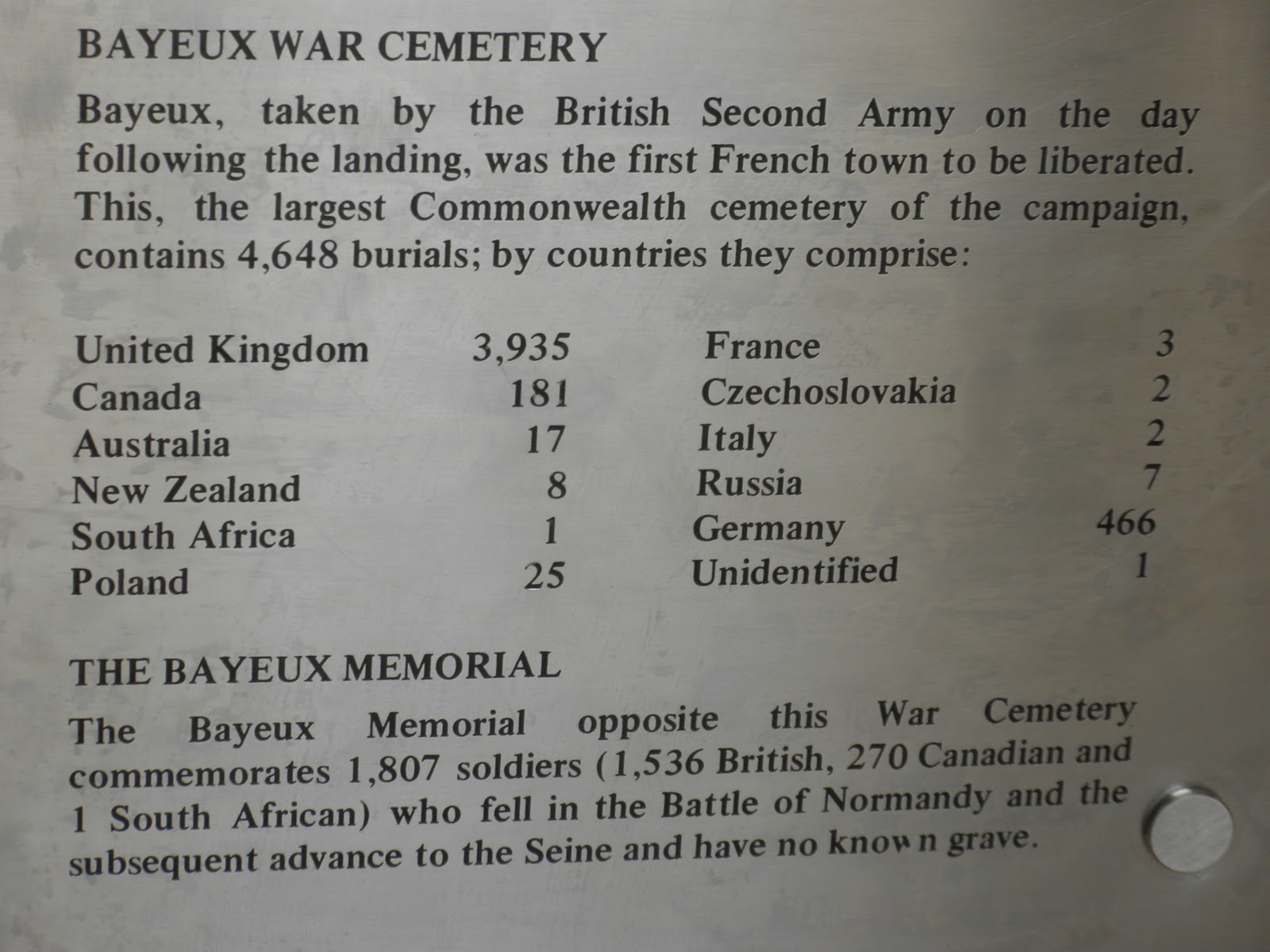
A chart at the Bayeux English cemetery lists the people in the cemetery, showing it's not really just an English cemetery. Eight New Zealanders are buried there, as you can see, along with people from nine other countries.


In the film at the Bayeux Tapestry museum, they mentioned the engraving along the top of the monument below, at the English Cemetery in Bayeux, which says in Latin "We who were conquered by William have returned to liberate the land of the conqueror."


I have to say, we went to Normandy because Dave had read so much about the D Day beaches. I was only vaguely interested. But I found the whole experience much more moving than I expected, bringing tears to my eyes many, many times.